The Industrial Internet of Things keeps promising the same thing: turn physical reality into data, and let software act on it. Cameras capture images. Vibration sensors capture machine health. RFID captures identity.
But there is one physical property that almost everything in commerce and industry has, which almost nothing reports: weight.
Weight tells you how much is left, how much was used, how much arrived, and how much left without permission. It is the most direct measure of quantity of matter that exists — and for most operations, it is still invisible.
The sensing layer the IoT forgot
The IoT’s core challenge has always been the edge: converting analog physical reality into digital information a computer can manage. Load cells are among the oldest, most mature, and most reliable answers to that challenge — strain-gauge metrology has been trusted for decades wherever accuracy matters.
What changed is everything around the load cell:
- Digital transmitters now condition and convert the mV/V signal at the sensor
- Ethernet and wireless connectivity push live weight data straight to platforms — no dedicated cabling projects
- Cloud analytics turn raw weight streams into inventory counts, consumption forecasts, and anomaly alerts
In other words: the load cell has quietly become an IoT-native sensor. Install it under anything that holds material, and you have a continuous, self-reporting inventory point.
Where weight data is already working
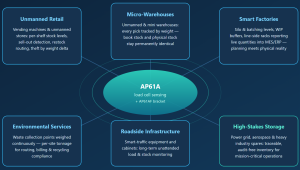
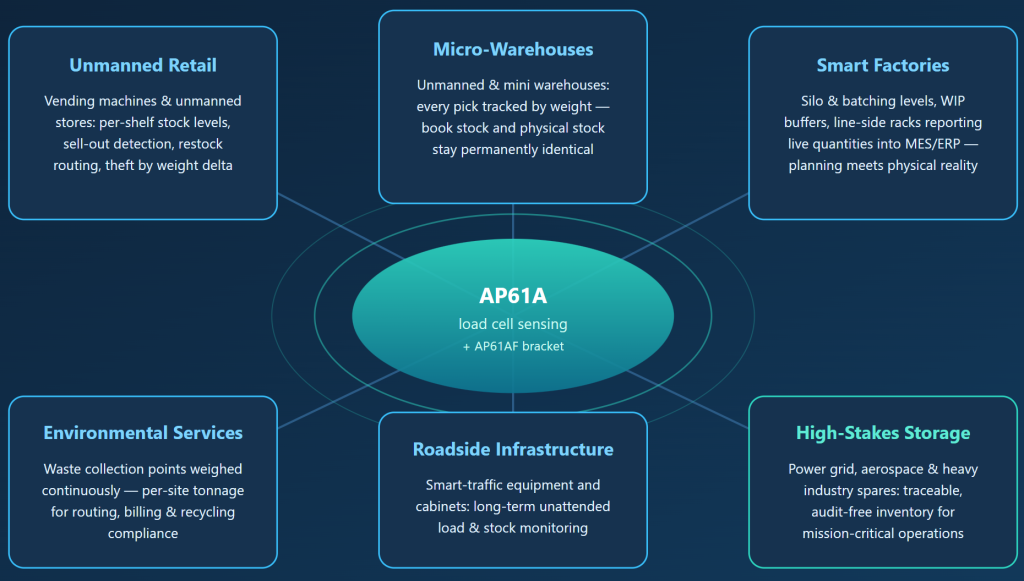
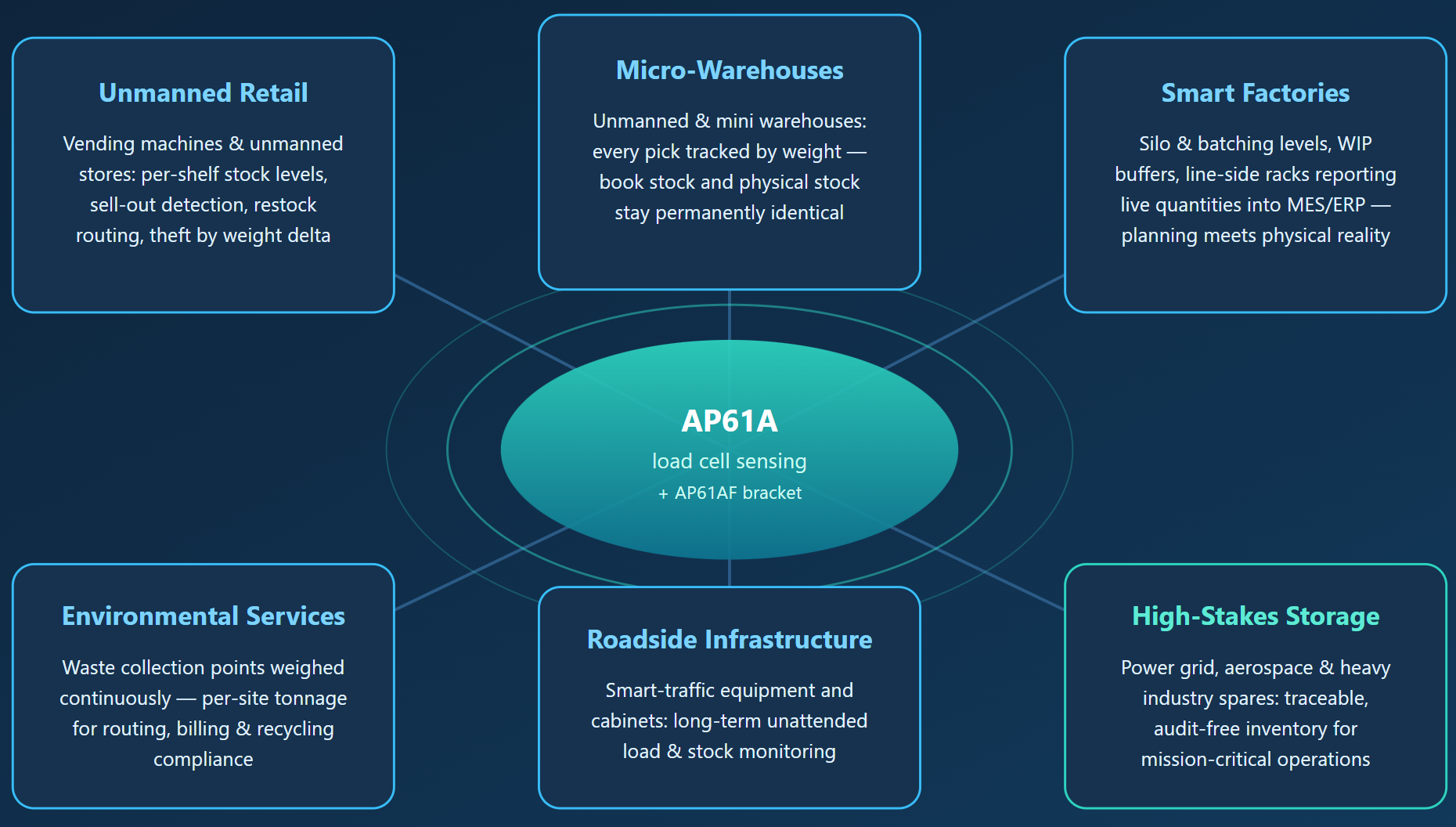
Weight-based IoT sensing has moved far beyond the warehouse scale. Live deployments today include:
Unmanned retail
Vending machines and unmanned stores monitor stock per column and per shelf in real time — detecting sell-outs, planogram compliance, and even theft by weight delta, and triggering route-optimized restocking.
Unmanned and micro-warehouses
Automated mini-warehouses track every pick by weight, keeping book stock and physical stock identical without a single barcode scan.
Environmental services
Municipal waste programs weigh collection points continuously, generating per-site fill and tonnage data for routing, billing, and recycling compliance — data that used to require truck scales and paperwork.
Smart traffic and roadside infrastructure
Equipment enclosures and cabinets report long-term loads and stock status over years of unattended operation, where sensor stability and low drift are non-negotiable.
Smart factories
Beyond storage: raw-material silos, batching stations, and work-in-process buffers all report live quantities into MES/ERP, closing the loop between planning and physical reality.
What a good IoT load cell must do
IoT duty is harder than it looks. The sensor sits at the edge — unattended, powered remotely, expected to run for years between services. That defines the spec:
- Zero-point stability. If the sensor drifts, the inventory count drifts. Analytics downstream are only as honest as the millivolt signal upstream.
- Resolution at the low end. Distinguishing “one part removed” from noise is the whole point — the sensor must resolve fractions of a percent of bin weight.
- Environmental toughness. Temperature swings, humidity, vibration, and RFI are the operating conditions, not the exceptions.
- Mechanical repeatability. In IoT storage applications, bins are handled, restacked, and refilled constantly. The load path must return identical readings after every disturbance.
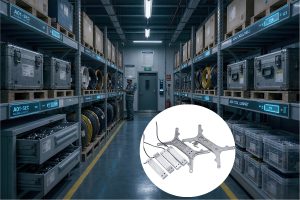
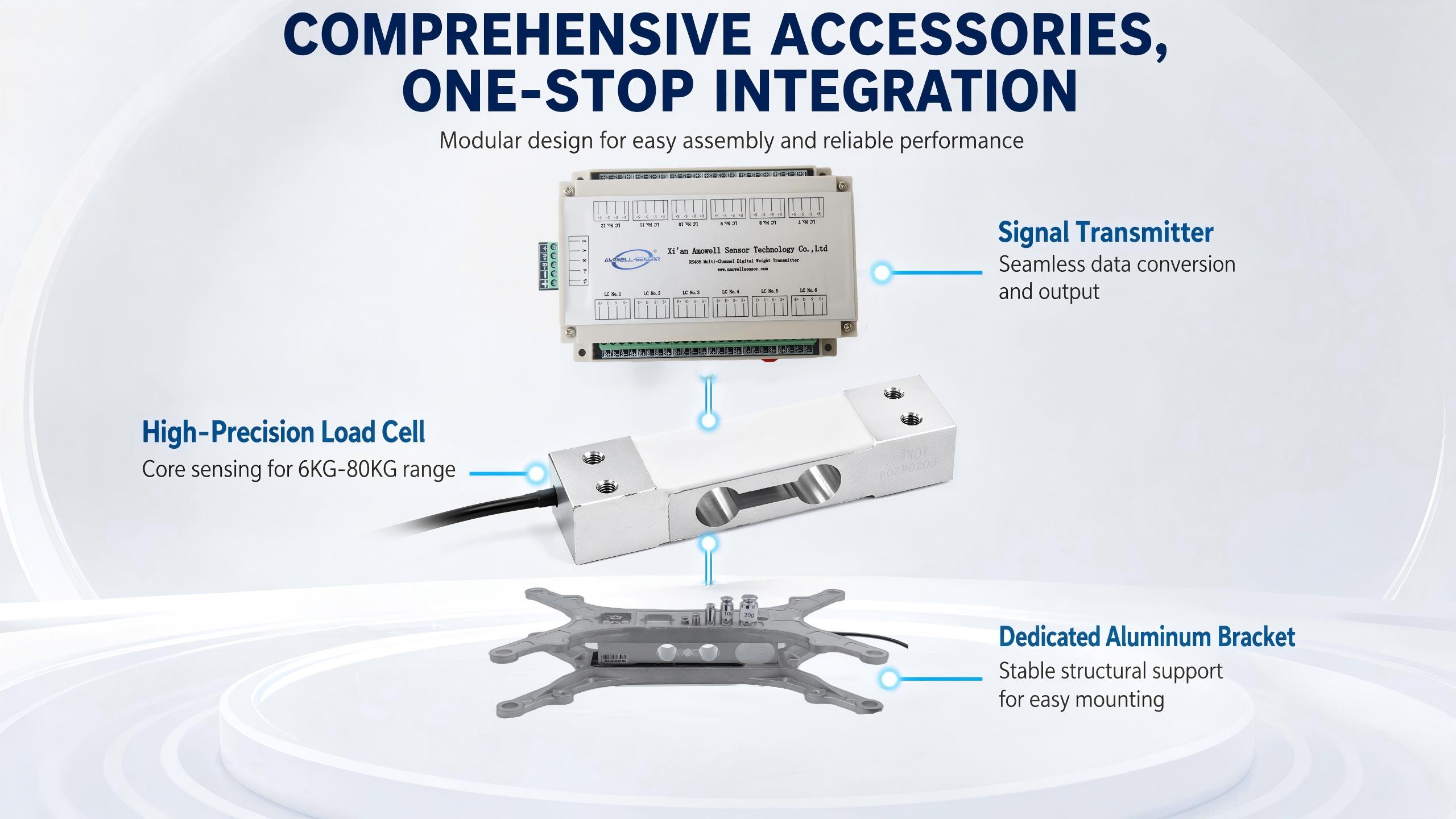
The AP61A single point load cell was engineered against exactly these four requirements, with the AP61AF aluminum bracket S M L H size ensuring the mechanical repeatability that keeps deployed systems accurate across years of unattended service. The sensor boasts high precision and is compatible with AWCM digital transmitters, division value up to 0.1g.
The quiet advantage: no behavior change
Every other auto-ID method demands something of the human: scan, tap, tag, type. Weight sensing demands nothing. People simply use material as they always have, and the data appears.
That is why weight-based sensing is spreading fastest where human discipline is the weakest link — shared tool cribs, line-side racks, remote depots, unmanned points of presence. The system cannot be forgotten, because there is nothing to remember.
From sensor to strategy
For system integrators and platform vendors, the message is simple: weight is a data stream you can add to almost any “how much is there?” problem, at hardware cost that RFID-per-item economics can’t touch.
The next generation of smart infrastructure won’t just know where things are. It will know how much of everything exists, everywhere, all the time. That future is assembled one load cell at a time.
Designing an IoT application that needs honest quantity data? Explore the AP61A series or request engineering samples for your prototype.
[Talk to Amowellsensor →info@amowellsensor.com]
Amowellsensor supplies precision load cells and mounting hardware to smart-storage system integrators worldwide.