Some industries cannot afford inventory errors. When a power grid crew arrives at a substation, when an aerospace maintenance team opens the spares cabinet, or when a heavy-industry plant schedules a critical overhaul, a missing or miscounted part doesn’t just cost money — it stops the mission.
Yet in exactly these environments, material warehouses are still often run on paper records and ERP entries maintained by hand. Manual bookkeeping works while warehouses are small and staff are experienced. It fails as scale grows:
- Recorded quantities drift away from physical stock, and nobody knows which number is true
- Repeated physical counts burn enormous labor hours across distributed warehouse sites
- Slow, error-prone workflows conflict with industries where safety and quality standards are uncompromising
- Material flows — new stock in, transfers, repairs, scrap — are not traceable end-to-end
For power systems, aerospace programs, and heavy equipment manufacturers, digitizing material management is not a convenience project. It is a compliance and continuity requirement.
Weighing as the backbone of traceable material flow
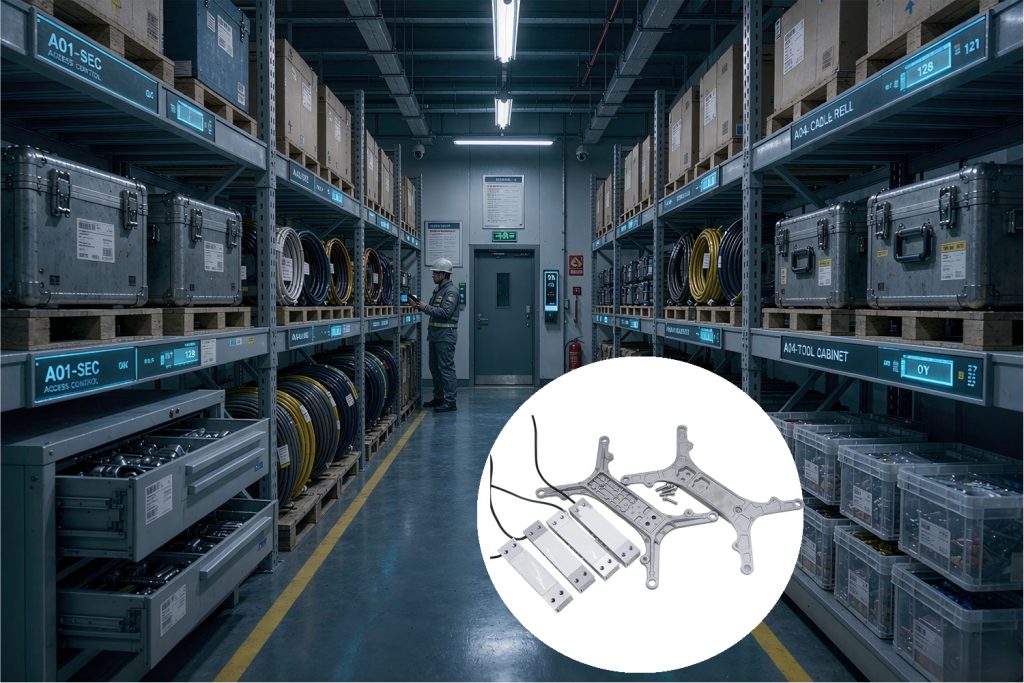
The proven architecture in these industries is the smart weighing shelf: every storage location instrumented with a precision load cell, continuously reporting live stock levels to a central management platform.
Implemented for a regional power grid operator, the concept delivered a fully digital material loop:
- Every movement is captured automatically — receipts, issues, transfers, and returns generate their own records
- Live inventory for every SKU, at every site, visible centrally — one version of the truth
- Threshold alerts notify responsible staff by system notification and email before stock runs out
- Full traceability: who took what, when, and in what quantity — with no operator keystrokes required
For an aerospace logistics operation, the same principle keeps book stock and physical stock permanently aligned: cycle counting becomes a background process, not a quarterly event. And in a heavy-industry spares cabinet — as deployed at a major Chinese heavy-machinery plant — each bin location pairs weighing with a per-location display, so operators see quantity, status, and picking guidance at the shelf itself.
Why these industries choose load-cell-based sensing
High-standard facilities evaluate several auto-ID technologies. Weight sensing wins repeatedly because it is:
- Passive for the operator. No scanning, no tags on every item, no behavior change. Parts are simply taken — and counted.
- Count-agnostic to packaging. A bin of 500 bolts, a kit, a bag, a loose assembly — weight sensing counts all of them, where barcode/RFID per-item tagging is uneconomical for low-value, high-volume parts.
- Continuously truthful. The system doesn’t sample inventory at audit time; it knows inventory every second of every day.
- Retrofit-friendly. Load cells and brackets mount into existing racking and cabinets — no greenfield construction required.
Engineered for the environment — and for accuracy
Grid warehouses, aerospace stores, and plant MRO rooms share tough conditions: wide temperature ranges, vibration, dust, and constant handling. That is where the sensing hardware earns its keep.
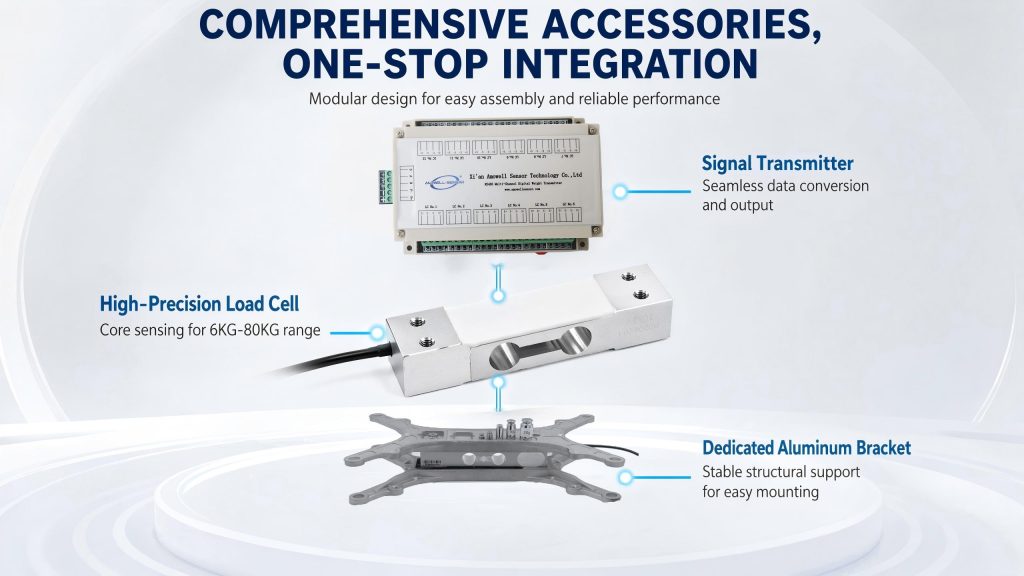
The AP61A single point load cell brings the metrological stability these applications demand — consistent repeatability so that gram-level changes in bin weight convert reliably into unit counts, shift after shift, year after year. The matching AP61AF series S M L H size aluminum brackets provide the rigid, aligned force path that protects that accuracy in daily use: bins can be removed, refilled, and replaced without disturbing measurement quality.We can also provide AWCM high-precision digital transmitters with RS485 Modbus output, a minimum division value of 0.1g, and customizable USB and aviation connector interfaces.
Together they give system integrators a sensing layer that is:
- Mechanically stable — sway-free bin guidance and overload protection
- Fast to install — standardized bracket geometries suit rack, cabinet, and shelf-bin layouts
- Lightweight and corrosion-resistant — aluminum construction suited to demanding industrial environments
The common denominator of high-stakes storage
Whether the mission is keeping a grid energized, an aircraft fleet flying, or a steel mill through its overhaul window, the requirement is identical: know what you have, right now, without depending on anyone to write it down.
Smart weighing shelves deliver that certainty — and they start with a load cell you can trust.
Building a smart storage project for power, aerospace, or heavy industry? Our team supports integrators with sensing selection, bracket customization, and engineering samples.
[Talk to Amowellsensor → info@amowellsensor.com]
Amowellsensor supplies precision load cells and mounting hardware to smart-storage system integrators worldwide. Case descriptions in this article are anonymized and based on published industry deployments.