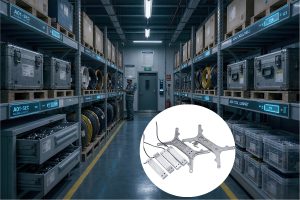
Walk onto any modern assembly floor and you will find the same quiet problem: a line-side rack holding hundreds — sometimes thousands — of small parts, and no one who can tell you exactly how many are left.
Advanced manufacturers routinely juggle more than 2,000 different part SKUs with high daily consumption. Operators take what they need from traditional racks, and the data that flows back to management is based on memory, estimation, and end-of-shift paperwork. The result is a familiar set of failures:
- No visibility into how much material was actually consumed vs. simply taken
- Reorder quantities driven by operator experience rather than data
- Hidden waste, hoarding, and shrinkage nobody can quantify
- Stock-outs that stall the line, or overstock that ties up cash and floor space
Paper logs and ERP entries can’t fix this, because the data is entered after the fact, by humans, from memory. The only way to make line-side inventory honest is to measure it continuously and automatically.
The answer already sits under the bin: weight
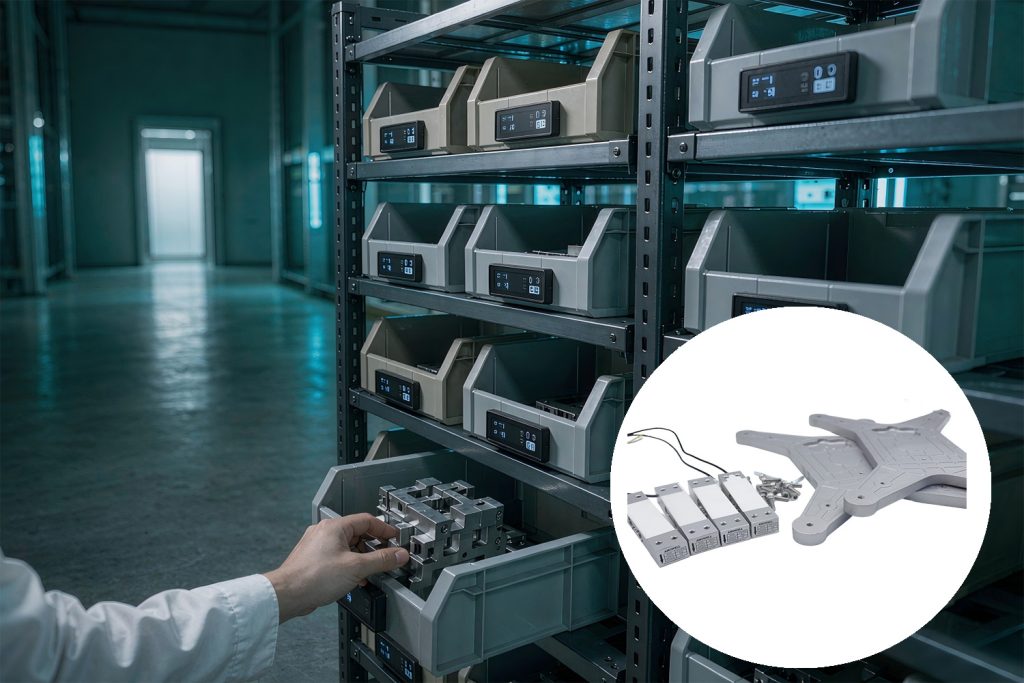
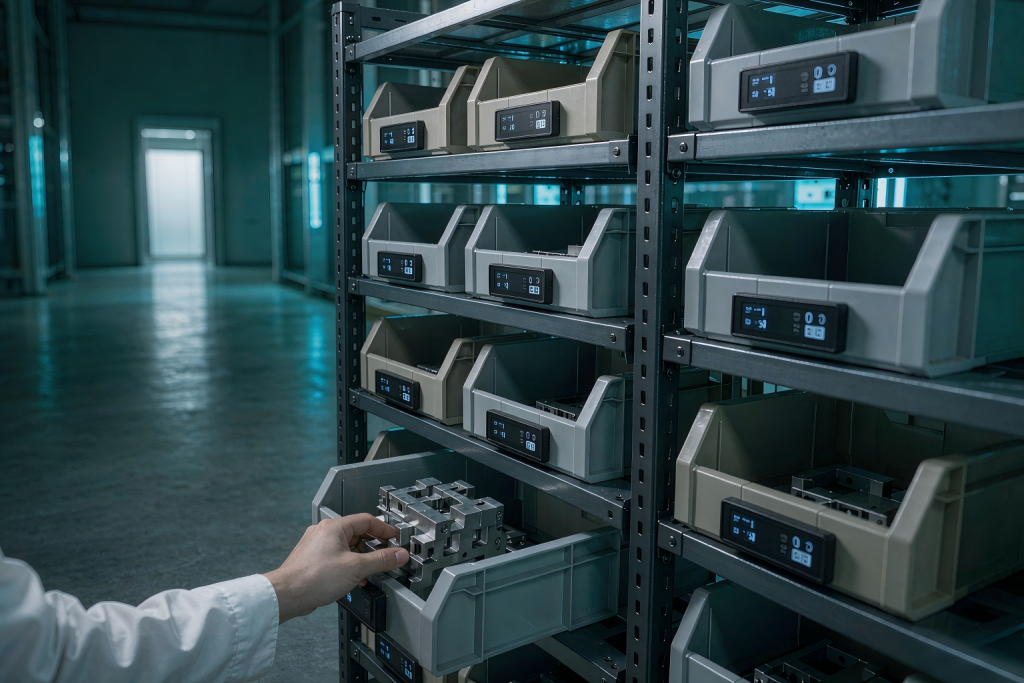
Every storage bin on a smart shelf rests on a precision load cell. Each time an operator picks a part, the weight of the bin changes — and the change is captured instantly, converted into quantity, and pushed to the warehouse management system.
No scanning. No barcode. No login. No extra seconds added to the operator’s day.
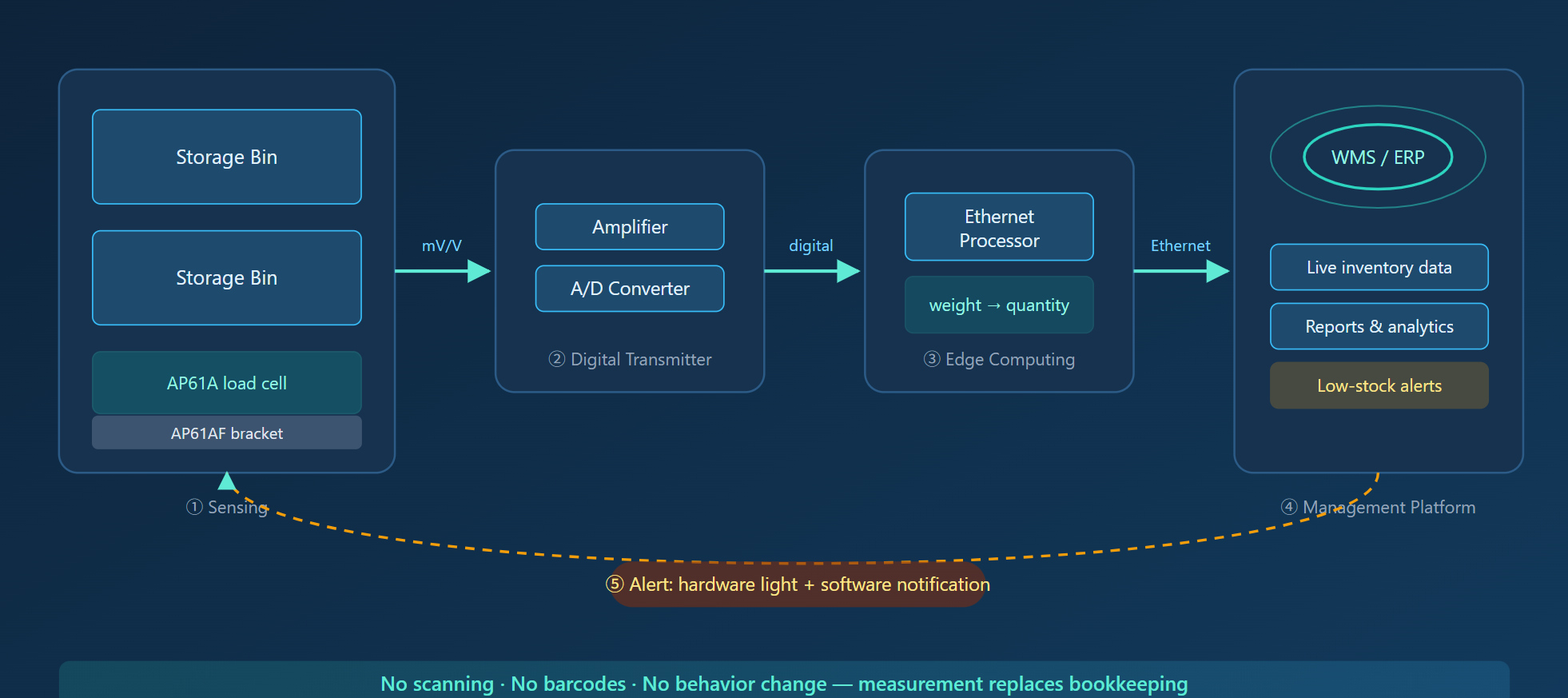
The measurement chain is simple and robust:
- AP61A single point load cells under each storage location sense micro-changes in bin weight (Amowellsensor)
- AP61AF aluminum mounting brackets hold the load cell and bin in a mechanically stable, sway-free position(Amowellsensor)
- The AWCM RS485 digital transmitter conditions and digitizes the signal(Amowellsensor)
- An Ethernet processor streams live weight and computed quantity to the WMS/ERP (customer device)
- When stock falls below a defined threshold, alerts fire on both the hardware (indicator light) and the software (notification/email) (customer device)

What changes on the floor
Across deployments in manufacturing line-side warehouses, consumables management, and fastener storage, weight-based smart shelving consistently delivers:
| Before (manual) | After (weight-based smart shelf) |
|---|---|
| End-of-shift physical counting | One-click inventory check — counts generated automatically, exportable as a report |
| Consumption reported from memory | Every pick recorded with time stamp and quantity, traceable |
| Reorder by gut feeling | Replenishment driven by real consumption-rate analytics |
| Stock-outs discovered when the line stops | Low-stock alerts before the bin runs dry |
| Physical inventory ≠ system inventory | Live weight data keeps book stock and real stock matched |
| No accountability for picks | Pick logs provide loss-prevention traceability |
For fastener and hardware storage in particular, the model shifts to “one refill, many picks”: bins are replenished once, and dozens of partial withdrawals are tracked automatically — something barcode-per-part approaches simply cannot economically do for a bag of screws worth a few cents.
Why the load cell choice decides everything
A smart shelf is only as good as its sensing element. The bin weight signal is small, continuous, and lives in a noisy industrial environment — vibration from forklifts, temperature drift, RFI. That is why we engineer the AP61A for exactly this duty:
- High-resolution output that can distinguish a single small part from bin tare noise,Resolution up to 0.1g
- Long-term zero stability so the “inventory = weight ÷ unit weight” calculation stays accurate for months between calibrations
- A compact footprint that fits standard shelf locations (130*30*22mm)
- Paired AP61AF aluminum brackets that provide rigid, consistent force introduction — protecting accuracy even when bins are slid, bumped, or restacked,easy installation.
From line-side to everywhere
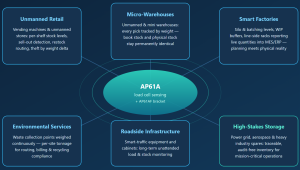
The same principle scales beyond the factory line: unmanned warehouses, MRO cabinets, 3PL picking walls, and even unmanned retail. If material sits in a bin, its inventory level can be a live data stream — no tags, no scans, no counting.
Want to evaluate weight-based inventory for your racks? Talk to our engineers about the AP61A + AP61AF combination, request the specification sheet, or send us your bin dimensions for a quick feasibility check.
[Contact Amowellsensor → info@amowellsensor.com]
Amowellsensor supplies precision load cells and mounting hardware to smart-storage system integrators worldwide. Product specifications referenced in this article are available on request.