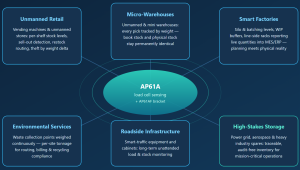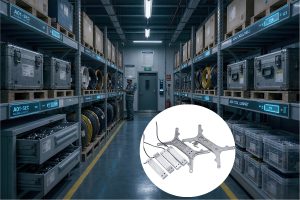
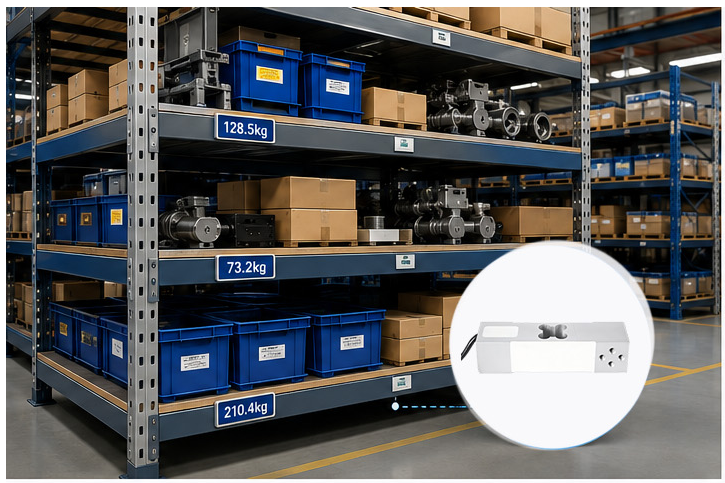
A warehouse can have a modern WMS, ERP and automation equipment—and still face a simple problem: the digital inventory does not always match what is physically on the shelf.
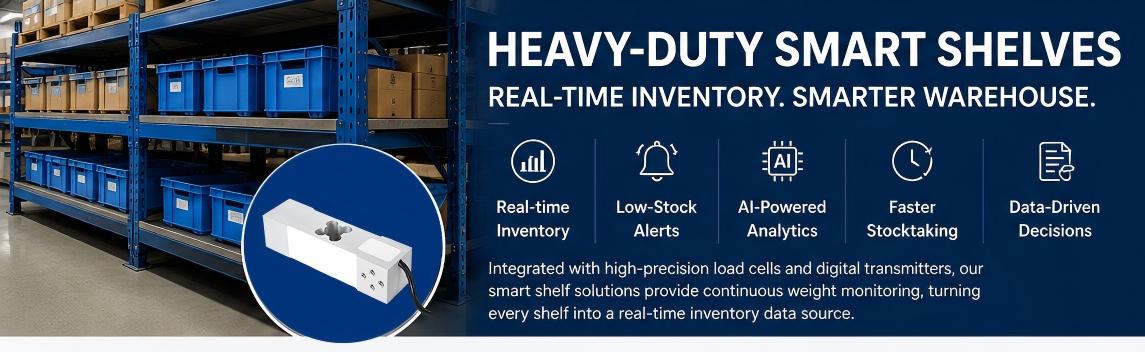
Heavy-duty smart shelves address this gap by adding a sensing layer directly to the storage structure. Load cells measure changes in physical load, digital weighing transmitters convert those measurements into usable data, and the customer’s IoT, WMS or ERP environment can use that data for inventory visibility, alerts and analysis.
For industrial spare parts, electrical materials, MRO inventory, automotive components and other heavier items, this approach turns a traditional rack into a measurable point in the warehouse.
| In one sentence A shelf weight sensor does not replace the WMS. It gives the WMS another source of physical inventory data—directly from where the material is stored. |
Why Heavy-Duty Smart Shelves Matter Now
Warehouse modernization is increasingly moving toward connected systems rather than isolated automation. A 2026 Fortune Business Insights report estimates the global smart warehousing market at USD 32.68 billion in 2026, with a projected 14.96% CAGR from 2026 to 2034. The report also identifies IoT and AI among the technologies shaping smart warehousing, with Europe accounting for 26.45% of the global market in 2025. These figures do not mean every warehouse needs a fully automated facility; they do show why connected sensing and data visibility are becoming part of warehouse modernization.
At the same time, AI is becoming more relevant to inventory management, forecasting and warehouse optimization. A 2026 market report on AI in warehousing projects strong growth through 2034 and identifies inventory management, warehouse optimization and supply-chain visibility as important application areas. For AI to be useful, however, the underlying operational data still has to come from somewhere.
| The practical opportunity Instead of asking AI to guess what is happening in a warehouse, start by capturing reliable physical signals from the storage environment. |
How a Heavy-Duty Smart Shelf Works
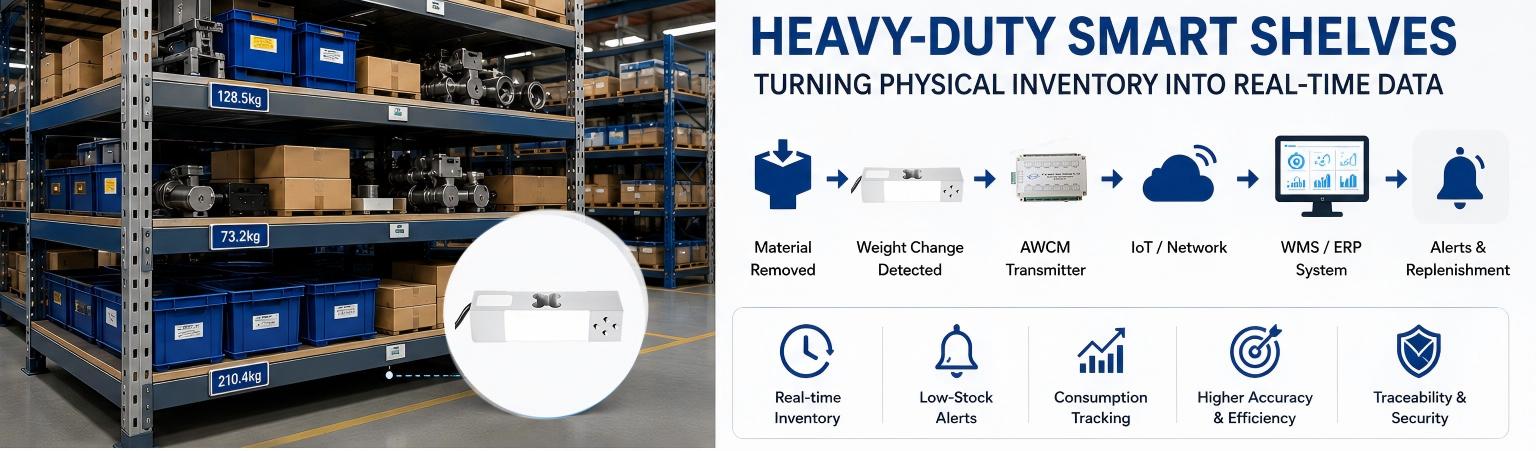
The architecture is straightforward. A load cell becomes the sensing point under a shelf, tray or platform. The AWCM digital weighing transmitter collects the sensor signal. From there, the customer’s communication and software architecture can move the data into an IoT gateway, WMS, ERP or analytics platform.
| 1. Material | 2. Load Cell&Frame | 3. AWCM weight transmitter | 4. IoT / Network | 5. WMS / ERP | 6. Action |
| Stored, picked, returned or replenished | Detects a physical weight change | Processes and communicates weighing data | Moves data into the customer’s system | Maps data to location, SKU and inventory logic | Alerts, replenishment, analysis or review |
The key idea is simple: every material movement creates a physical change. A weight-based sensing layer can capture that change without requiring every movement to be manually counted.

Where Heavy-Duty Smart Shelves Can Be Used
Industrial spare parts — Bearings, motors, valves, replacement components and maintenance stock.
Electrical & power systems — Electrical components and maintenance materials where stock accuracy and traceability matter.
MRO & tools — Tools, consumables and maintenance items with frequent picking and replenishment.
Automotive parts — Heavier components and bins where shelf-level inventory visibility can support faster replenishment.
Manufacturing materials — Production-support materials that need to remain available close to the point of use.
Smart warehouse platforms — Totes, trays, bins and larger weighing platforms integrated into a connected warehouse.
The Warehouse Problems a Weight-Sensing Layer Can Address
| Common challenge | What can happen | Weight-sensing approach |
| Manual stocktaking | Counts take time and may need to be repeated. | Monitor physical load changes and reduce reliance on routine manual checks. |
| Inventory discrepancy | ERP/WMS records can diverge from physical stock. | Add physical weight data as another inventory signal. |
| Low-stock visibility | Replenishment may happen after a shortage is discovered. | Use measured weight against customer-defined thresholds. |
| Temperature changes | Sensor output can be affected by environmental conditions. | AP62A can be customized with temperature compensation from -40°C to +60°C. |
| Uneven loading | A single sensing point may not represent a larger platform well. | Use an appropriate bracket/frame or a four-cell AF91A platform configuration. |
| Integration complexity | Engineering teams need a practical way to test sensor data. | AWCM can be paired with test software during system development. |
Solution A: AP62A Single Point Load Cell + Aluminum Frame Solutions
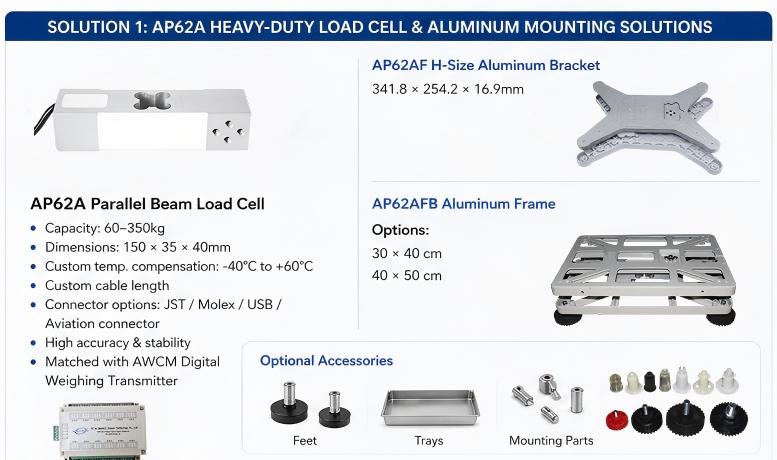
The AP62A is a parallel beam load cell for heavy-duty shelf and platform integration. Its 60–350 kg capacity range makes it suitable for heavier bins, industrial shelves and structured storage applications.
| AP62A specification | Details |
| Capacity | 60–350 kg |
| Dimensions | 150 × 35 × 40 mm |
| Temperature compensation | Customizable, -40°C to +60°C |
| Cable length | Customizable |
| Connector options | JST / Molex / USB / Aviation connector |
| Digital system | Compatible with AWCM digital weighing transmitter |
| Typical integration | Heavy-duty shelves, industrial racks, bins and weighing platforms |
For system integrators, the AP62A can be specified around the mechanical and wiring requirements of the shelf. Custom cable length and connector options can simplify harness routing and field installation.
AP62AFH Aluminum Bracket
The AP62AF mounting solution can be matched with an H-size aluminum bracket measuring 341.8 × 254.2 × 16.9 mm. The bracket provides a mechanical structure for integrating the AP62A with a shelf or weighing platform.
AP62AFB Aluminum Frames
For larger platform-style applications, AP62AFB aluminum frames are available in 30 × 40 cm and 40 × 50 cm options. The platform structure can also be configured with accessories such as support feet, trays and mounting components, depending on the application.
| Mechanical design matters A load cell only performs as intended when the load reaches the sensing element through a suitable mechanical structure. Bracket geometry, platform rigidity, load distribution and installation all need to be considered during system design. |
Solution B: AF91A Ultra-Thin Planar Beam Load Cell
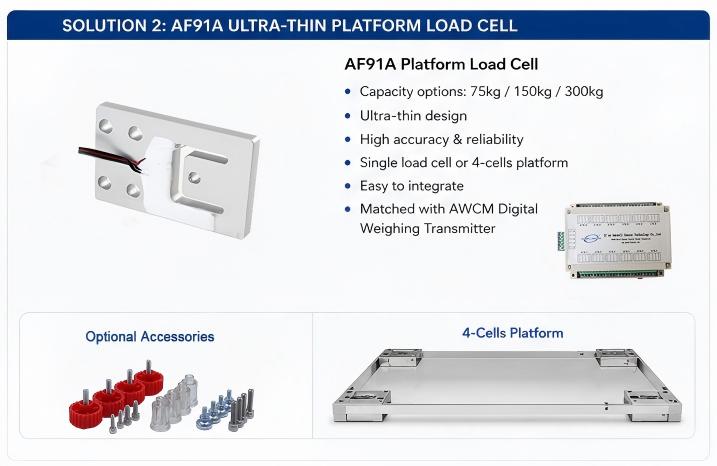
Not every heavy-duty application has room for a large sensor assembly. The AF91A is an ultra-thin platform load cell for applications where installation height and platform integration are important.
| AF91A feature | Details |
| Capacity options | 7.5kg/30kg/75 kg / 150 kg / 300 kg |
| Profile | Ultra-thin platform design |
| Configuration | Single sensor or four-sensor platform |
| Typical applications | Trays, totes, low-profile platforms and compact weighing structures |
| System integration | Can be combined with AWCM and the customer’s data architecture |
A four-sensor configuration can be used when the platform is larger and the load needs to be measured through multiple support points. The final mechanical design should be matched to the platform size, load distribution and installation conditions.
AP62A vs AF91A: Which Solution Fits Your Shelf?
| Feature | AP62A + AP62AF / AP62AFB | AF91A |
| Best fit | Heavy-duty rack and shelf integration | Low-profile platform and tray integration |
| Capacity | 60–350 kg | 7.1/30/75 / 150 / 300 kg |
| Form factor | Parallel beam | Ultra-thin platform load cell |
| Mechanical options | H-size bracket; 30×40 cm / 40×50 cm frames | Single sensor or four-sensor platform |
| Temperature compensation | Customizable -40°C to +60°C | Customizable -40°C to +60°C |
| Connector options | JST / Molex / USB / Aviation connector | Application-dependent |
| Recommended when | You need a structured heavy-duty shelf or platform | You need a compact, low-profile weighing structure |
AWCM Weight Transmitter : The Digital Link Between the Sensor and the System
The load cell provides the physical measurement. The AWCM digital weighing transmitter provides the digital interface for system development and integration. It can collect load-cell signals and communicate weighing data through the customer’s system architecture.
- Use AWCM during engineering development and sensor evaluation.
- Use the available test software to check weighing data before connecting the complete warehouse system.
- Build the communication layer around the customer’s IoT gateway, WMS, ERP or analytics platform.
- For multi-sensor or multi-shelf projects, define channel mapping and shelf/location IDs during system architecture design.
Representative Application Scenarios
The following scenarios are representative solution patterns rather than named customer case studies. They are intended to show how the hardware can be applied without presenting unverified customer performance figures as factual results.
Industrial spare-parts warehouse
Challenge: Manual cycle counts and frequent stock movements make it difficult to maintain physical inventory visibility.
Solution approach: AP62A + AP62AF/AF62AFB mounting structure + AWCM. Weight changes can be mapped to shelf and SKU data in the customer’s WMS.
Electrical & power-system materials
Challenge: Many SKUs and repeated material movements can create discrepancies between records and physical stock.
Solution approach: Weight sensing adds a physical inventory signal that can support stock monitoring, threshold alerts and traceability workflows.
MRO & tools
Challenge: Tools and consumables may be picked frequently and replenished irregularly.
Solution approach: AF91A single or four-sensor platforms can be integrated under trays or tool-storage platforms for weight-based monitoring.
Automotive parts distribution
Challenge: Heavy components and bins require robust mechanical integration and reliable data capture.
Solution approach: AP62A with customized cable routing and temperature compensation can be designed into the shelf structure, subject to application validation.
Where AI Fits in a Weight-Sensing Smart Warehouse
AI should not be treated as a replacement for the sensing layer. It becomes more useful when the warehouse already has structured operational data.
| Layer | Question it helps answer |
| Load cell | What physically changed? |
| AWCM / digital layer | What is the measured weight? |
| WMS / ERP | Which shelf, location or SKU does it relate to? |
| Analytics | Is this change normal compared with historical consumption? |
| AI | What may happen next, and which inventory action should be considered? |
For example, if a shelf’s measured weight falls faster than its historical pattern, the analytics layer can flag the change. The AI layer can then support demand forecasting or replenishment recommendations. The exact workflow depends on the customer’s software and data model.
From Load Cell to Live Inventory: A Practical Integration Checklist
- Define the load range and shelf structure. Choose AP62A for structured heavy-duty rack integration or AF91A for low-profile platform applications.
- Choose the mechanical interface. Consider the AP62AF H-size aluminum bracket, AP62AFB 30 × 40 cm / 40 × 50 cm frames, trays, feet and other mounting parts as required.
- Configure the digital weighing layer. Use AWCM and its test software during development and validation.
- Specify cable routing and connectors. Select cable length and JST, Molex, USB or aviation connectors according to the installation.
- Map the sensing point to the warehouse system. Define sensor/channel ID, shelf location and SKU relationships.
- Set inventory logic. Define thresholds, replenishment rules and exception handling in the customer’s software.
- Validate the complete mechanical and software system. Test loading conditions, temperature effects, vibration, cable routing and communication before production deployment.
Why Build the Sensing Layer into the Shelf?
A barcode tells the system what was scanned. RFID can identify tagged objects. Cameras can provide visual information. A load cell answers a different question: how much physical load is actually present at the storage point?
For heavy-duty inventory, that physical signal can be valuable because it is measured where the material sits. When combined with other identification and software technologies, weight data can become one component of a broader smart warehouse architecture.
Frequently Asked Questions
What is a shelf load cell sensor?
A shelf weight sensor is a load-cell-based sensing solution integrated into a shelf, tray or platform to detect changes in physical load. When connected to digital electronics and software, those changes can support inventory monitoring.
Which load cell is suitable for heavy-duty smart shelves?
AP62A is designed for 60–350 kg applications and is suitable for structured heavy-duty shelf integration. AF91A offers 75 kg, 150 kg and 300 kg options for ultra-thin platform applications.
Can AP62A be used with an aluminum bracket?
Yes. AP62A can be matched with the AP62AF H-size aluminum bracket measuring 341.8 × 254.2 × 16.9 mm, and AP62AFB aluminum frames in 30 × 40 cm and 40 × 50 cm sizes.
Can AF91A be used as a four-sensor platform?
Yes. AF91A can be configured as a single sensor or as a four-sensor platform, depending on the mechanical structure and load distribution.
Can AP62A be customized for temperature?
AP62A can be customized with temperature compensation from -40°C to +60°C. Exact performance should be validated against the final application conditions.
Can the sensor connect to a WMS or ERP?
The AWCM digital weighing transmitter can provide weighing data for integration into a customer’s communication and software architecture. The final WMS/ERP connection depends on the customer’s gateway, interface and software design.
What connector options are available?
For AP62A applications, cable length can be customized and connector options include JST, Molex, USB and aviation connectors.
Is AI required for a smart shelf?
No. A smart shelf can start with sensing and digital data collection. AI can be added later for forecasting, anomaly detection or replenishment recommendations when enough structured data is available.
From Smart Shelves to Intelligent Inventory
A load cell does one simple thing: it measures weight. But when that measurement is connected to a digital system, it can become part of a much larger workflow.
For heavy-duty smart warehouse projects, Amowellsensor provides AP62A load cells, AP62AF/AP62AFB aluminum mounting solutions, AF91A ultra-thin platform load cells and AWCM digital weighing transmitters. Together, these components can form the sensing layer of connected inventory systems for industrial storage, MRO, electrical materials, automotive parts and other heavy-duty applications.
The goal is not simply to make a shelf weigh itself. The goal is to make physical inventory easier to see, measure and connect to the systems that manage the warehouse.